
How to Save Emails and Attachments to SharePoint

How to Save Emails and Attachments to SharePoint using the SharePoint Explorer Outlook Add-In
This document describes how to save single and multiple emails & attachments to SharePoint using the SharePoint Explorer Outlook Add-In (drag & drop and context menu options).
Note: you need to configure the Add-In before it can be used to save emails.
Method I – Drag & Drop Emails to SharePoint
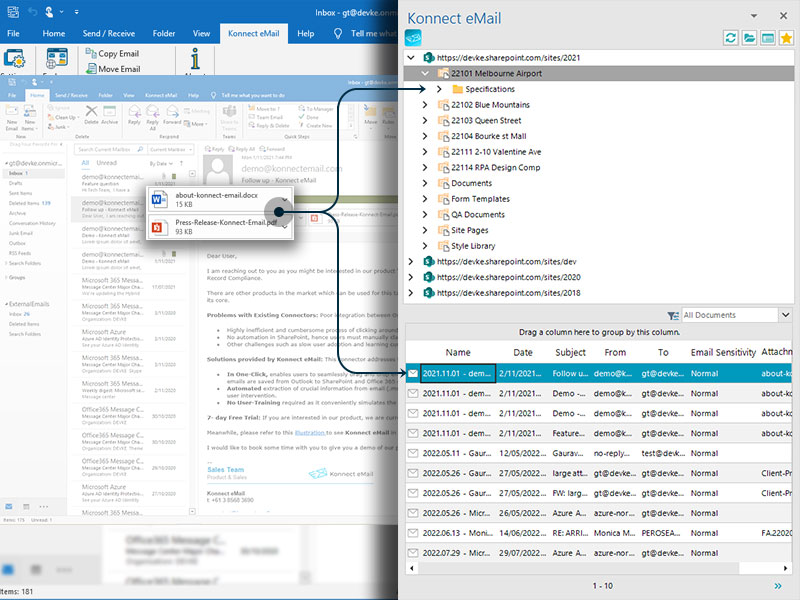
- Navigate to Konnect eMail tab on the Outlook application’s toolbar and click “Explorer”. This will open the Konnect eMail task pane – from here navigate to the SharePoint location when you want to save emails.

- Select 1 or more emails by holding down the Shift key and simply drag & drop the emails either on the desired library/folder or in the list view.
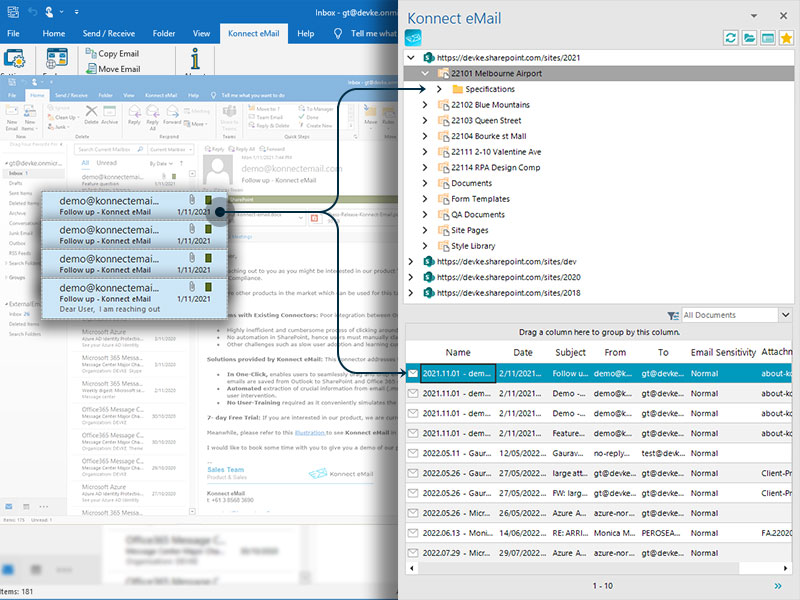
- Similarly for attachments – select 1 or more attachments by holding down the Shift key and simply drag & drop them either on the desired library/folder or in the list view.
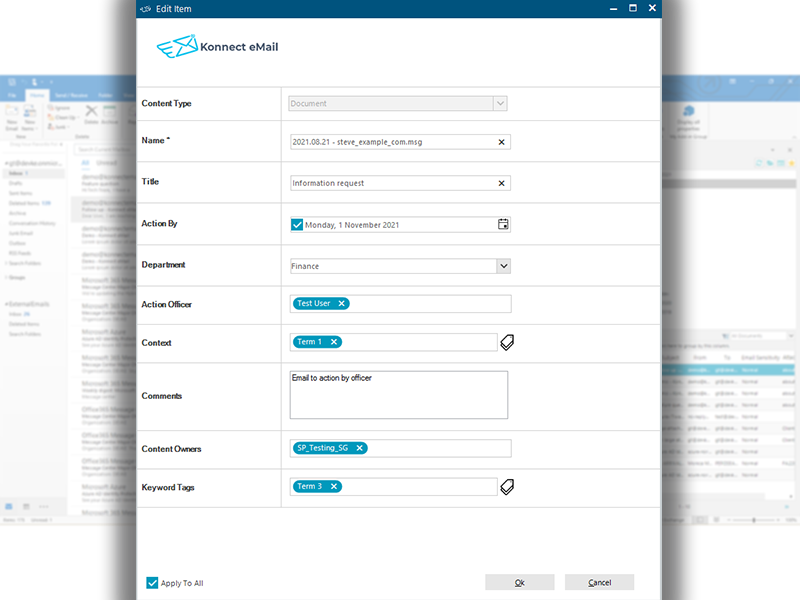
- The user will be prompted to enter any custom SharePoint metadata and hit “Ok”.
Method II – Email and Attachment Context Menus
- Select 1 or more emails by holding down the Shift key and right click on it to access the context menu. Find “Konnect eMail” and select “Copy to SharePoint” OR “Move to SharePoint”.

- Similarly for attachments – select 1 or more attachments by holding down the Shift key and right click on it to access the context menu. Find “Konnect eMail” and select “Save Attachment to SharePoint” OR “Save All Attachments to SharePoint”.

- A modal will appear for you to select the desired save location from your SharePoint sites list or from users favourite locations.
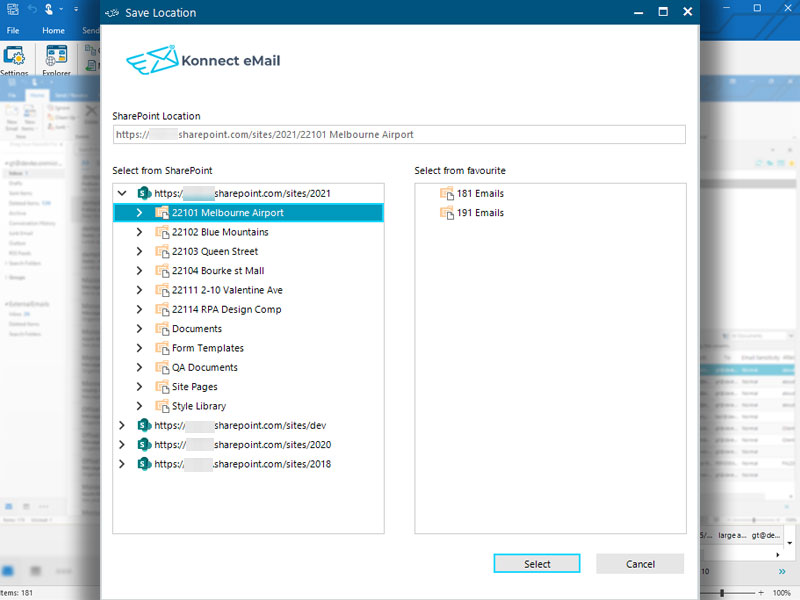
- After selecting the save location – the user will be prompted to enter any custom SharePoint metadata and hit “Ok”.

How to Save Outlook Attachments to SharePoint
Outlook emails often contain documents, spreadsheets, PDFs, images, and other files that need to be retained with the related communication. Instead of keeping these attachments only inside an individual mailbox, you can save them to the appropriate SharePoint location.
The general process is:
- Open the Outlook email containing the attachment.
- Identify the attachment you want to save.
- Select the appropriate save or SharePoint option.
- Choose the relevant SharePoint site, document library, or folder.
- Save the attachment.
- Verify that the file is available in SharePoint.
When deciding where to save an attachment, use the same SharePoint location and filing structure used for related project or client information. This makes it easier for authorized users to locate the document later.
If the email itself is important to the record, consider whether you need to save both the email and its attachment, rather than saving the attachment alone.
What Information Is Saved With the Email?
When an email is saved to SharePoint, the information retained can depend on the method and tools used.
Depending on the workflow, the saved email may include information such as:
- Email content
- Sender and recipient details
- Subject
- Date and time
- Attachments
- SharePoint metadata
- The selected SharePoint location
Metadata can be particularly useful when managing a large number of saved emails. Instead of relying only on folder structures, businesses can use relevant SharePoint metadata and search capabilities to help locate specific communications.
For this section, make sure the exact metadata supported by Konnect eMail is stated accurately. Don’t promise that a particular field is retained unless the product actually supports it.
Why Save Outlook Emails to SharePoint?
Moving important emails from individual inboxes into SharePoint can provide several practical benefits for businesses.
Centralize communication
Keep important emails together with the documents and information they relate to. This can make project or client records easier to manage.
Improve searchability
SharePoint provides search and metadata capabilities that can help users find saved communications without searching through an individual Outlook mailbox.
Support compliance
Storing important business communications within a controlled Microsoft 365 environment can support an organization’s information-management and retention processes.
Improve collaboration
Authorized team members can access relevant communications from a shared SharePoint location instead of relying on access to one person’s mailbox.
Reduce reliance on personal inboxes
Important business information does not have to remain inside an individual employee’s mailbox. Saving relevant communications to a shared repository can help preserve information when responsibilities change or team members move between roles.
Frequently Asked Questions
Q. Will saving an email to SharePoint remove it from Outlook?
No, saving creates a copy in SharePoint. The original stays in your Outlook mailbox unless you separately delete it.
Q. Can I save Outlook emails to Teams or OneDrive instead of SharePoint?
Yes, in a sense, Teams channel files are actually stored in SharePoint behind the scenes, and OneDrive is meant for individual (not shared) files. For team or client records, SharePoint is generally the right destination.
Q. Is there a size limit on attachments I can save?
This depends on your organization’s SharePoint storage limits and library configuration, not on Outlook itself check with your admin if you’re saving very large files.
Q. Can this be automated so I don’t have to save emails manually?
Yes, depending on your Microsoft 365 setup and the tools available, rules or add-in automation can file certain types of emails automatically as they arrive.
